How to Check if Your Trademark is Registered in China (2026)

August 20, 2026 -- 16 min read -- By Logo China Pro
Before a foreign brand spends a dollar filing a trademark in China, one step determines whether the application sails through or gets refused: the CNIPA trademark search. China's first-to-file system means the examiner checks your mark against more than 40 million existing records, and roughly 35 to 39 percent of applications are refused, mostly because of conflicts a proper search would have caught.
This guide walks through exactly how to search China's CNIPA trademark database for free, what to look for beyond exact matches, and how to read the results so you can file with confidence or pivot before wasting filing fees.
This article provides general information based on publicly available CNIPA resources and is NOT legal advice. Logo China Pro is a filing-coordination service that works with licensed specialist partners, not a law firm. For case-specific guidance, consult a qualified trademark attorney.
Quick Answer: What a CNIPA Trademark Search Tells You
- The CNIPA search portal is free but requires a registered account. The database at sbj.cnipa.gov.cn is open to anyone, but since 2023 CNIPA has required users to register and log in (using a Chinese mainland phone number) before running queries. Registration is free.
- An exact-match search is not enough. CNIPA refuses marks that are identical OR confusingly similar, so a real clearance search covers phonetic, visual, and conceptual conflicts too.
- You must search every variant of your mark. English name, Chinese character name, and pinyin transliteration each need separate queries, because squatters target the Chinese versions first.
- Sub-classes matter as much as classes. A clean result in one sub-class does not protect you in a neighboring sub-class within the same Nice class.
- The rejection rate is 35 to 39 percent. Most refusals trace back to conflicts a thorough search would have surfaced.
- A clearance search takes 1 to 3 business days when done properly and is the single highest-return step in the entire filing process.
Why the CNIPA Search Is the Most Important Step in Filing
China runs on a first-to-file rule. Under Article 35 of the 2026 revised Trademark Law, when two or more applicants file for the same or a similar mark, CNIPA examines and publishes the application filed first. The examiner's job during substantive examination is to compare your mark against every prior filing in the relevant classes and sub-classes. If a conflict exists, your application is refused, and the official filing fee is not refunded.
The math is unforgiving. The official CNIPA fee is CNY 270 (about USD 40) per class, non-refundable. Add agent fees, translation, and notarization, and a single-class filing costs USD 300 to USD 800. A refusal means losing that money plus 9 to 12 months of waiting, after which you re-file with a modified mark and pay again. A search that costs a fraction of the filing fee prevents all of it.
The search also reveals strategic information: whether a conflicting mark is owned by a legitimate competitor or a known squatter, whether it is still pending or already registered, and whether it has been unused long enough to be vulnerable to non-use cancellation. Each scenario calls for a different response, and you only see these details by searching before you file.
For the broader context on how first-to-file shapes the entire process, see Logo China Pro's guide on China's first-to-file trademark system.
What You're Actually Searching: The CNIPA Database
The China National Intellectual Property Administration maintains the official trademark database at sbj.cnipa.gov.cn. It contains every application filed with CNIPA, including pending applications, published marks, registered marks, opposed marks, and cancelled or expired marks. The database holds over 40 million active and pending records.
The portal supports several query types: word mark search (exact and contains), registration number search, applicant name search, and classification-based search. For a clearance search, the word mark search is the primary tool, supplemented by applicant name searches when investigating a specific conflict.
Each result record shows the mark text, the mark image (for design marks), the Nice class, the sub-class, the applicant name, the filing date, the application status, and the registration number if granted. Reading the status field correctly is critical: a pending application can still block your filing, and a registered mark in non-use range may be cancellable.
Source: CNIPA trademark search portal, sbj.cnipa.gov.cn.
Step-by-Step: How to Search China's CNIPA Trademark Database
A proper CNIPA search is not a single query. It is a structured process that covers every variant of your mark, every relevant class and sub-class, and every type of similarity the examiner will consider. Follow these six steps.
Step 1: Identify your mark and Chinese variants
List every version of your mark before touching the database. For most foreign brands that means the English word mark, any Chinese character name you intend to use, the pinyin transliteration, and any logo or combined mark. Each variant must be searched separately because a conflict on any one version can block your filing.
This is also where many foreign brands fail. They search only the English name, file, and then discover a squatter already registered the Chinese transliteration. The correct approach is to register three versions, the English mark, the Chinese character name, and the pinyin, and to search all three before filing any of them. For more on why this matters, see Logo China Pro's guide on trademark squatters in China.
Step 2: Determine your Nice classes and sub-classes
Map your products or services to the 45-class Nice system. A clothing brand needs Class 25; a software brand needs Class 9; a retail or e-commerce storefront needs Class 35. But China subdivides each Nice class into narrower sub-classes, and protection does not automatically extend across sub-classes within the same Nice class.
Using Class 25 (Clothing) as an example, sub-class 2501 covers clothing, 2507 covers footwear, and 2508 covers headgear. A brand that sells clothing and shoes must search and file in both 2501 and 2507, or it leaves footwear exposed. List every sub-class the brand currently uses and may reasonably expand into, then search each one.
For a full breakdown of how the sub-class system works, see Logo China Pro's China trademark basics guide.
Step 3: Run an exact-match search on the CNIPA database
Go to the CNIPA trademark search portal at sbj.cnipa.gov.cn/sbj/sbcx/ and run an exact-match query for each mark variant within your target classes. Record every hit, including the application status. An exact match is the clearest red flag: if someone already owns your exact mark in your exact sub-class, filing is almost certain to result in a refusal unless you oppose or cancel the prior mark.
Pay attention to the status field. A pending application can still mature into a registration that blocks you, so a pending conflict is nearly as serious as a registered one. A cancelled or expired mark is no longer a barrier. An opposed mark is in limbo and worth monitoring.

Step 4: Run phonetic and visual similarity searches
Exact matches are the easy part. CNIPA examiners also refuse marks that are confusingly similar, which covers phonetic equivalents and visual similarities. For word marks, search pinyin variants and homophones: a mark pronounced the same way but written with different characters can still be refused. For Chinese character marks, search characters with shared radicals or similar structures.
For design and combined marks, visual similarity matters. A logo with similar composition, color, or layout to an existing mark in the same class can trigger a refusal even if the text differs. This is the step where raw database queries fall short and specialist judgment adds the most value, because similarity is ultimately a subjective call by the examiner.


In the APPLE Class 9 example above, the top results include a Madrid registration (G870749) filed by Apple Inc. in 2006, another Madrid registration (G1413880) filed in 2018, a Chinese company's "Apple" mark (9125964) filed in 2011, and the mark (7594350) filed by a Zhongshan-based electronics company in 2009. The variety of owners and filing dates illustrates why each result needs individual assessment.
Step 5: Review conflict status and owner history
For each conflicting mark, dig into three fields: the owner name, the filing date, and the current status. Owner names that match known squatter patterns (shell companies filing across many unrelated classes) signal a bad-faith filing that may be challengeable under the 2026 revision's strengthened penalties. A filing date more than 3 years ago with no evidence of use opens the door to non-use cancellation. A pending application means an opposition may need to be prepared.
This step turns raw search results into a strategy. The same conflict can mean file anyway and oppose, file a modified mark, or seek cancellation, depending on who owns the conflicting mark and how they have used it.

The detail page above shows a registration publication date and an exclusive right period. Without checking further, the mark might appear to have been valid from 2011 to 2016. But the Process tab tells a different story -- an opposition was filed, and ruling number 2013-05681 upheld the opposition. The registration was refused and never took effect.


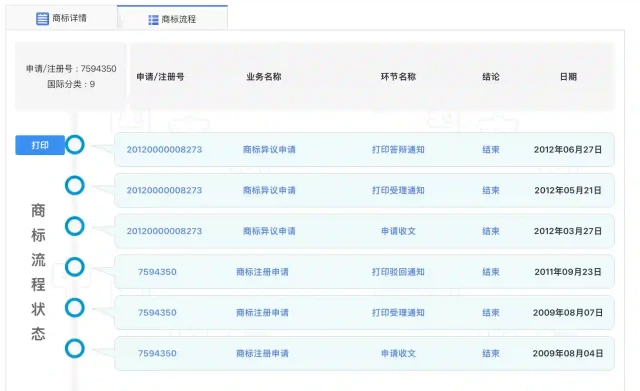
The lesson is critical: a registration publication date and an exclusive right period on the Details tab do not necessarily mean a mark is currently alive. If an opposition was filed before the publication window closed -- even one day before -- the registration can be overturned years later. The Process tab must be read all the way to the end, and the official Trademark Gazette entries should be cross-checked if there is any ambiguity. This is precisely the kind of nuance that a raw database search cannot surface on its own.
Step 6: Decide, file, modify, or oppose
With the search complete, make the filing decision. If the search is clean across all variants and sub-classes, file immediately to lock in the priority date, because protection effectively begins the day the application is filed, not the day the certificate arrives. If conflicts exist, choose between modifying the mark to avoid the conflict, narrowing sub-class coverage to sidestep the prior mark, filing and preparing to oppose the conflicting application, or negotiating a buyback if the owner is a squatter open to selling.
Document the reasoning behind the decision so the licensed agent can execute. The search is only valuable if it drives a clear filing strategy.
For the full filing workflow after the search, see Logo China Pro's step-by-step guide to registering a trademark in China.
Common Search Mistakes Foreign Brands Make
The same errors surface repeatedly when foreign brands attempt the CNIPA search themselves.
| # | Mistake | Why It Matters |
|---|---|---|
| 1 | Searching only the English name | China's market operates in Chinese characters. A clean English search reveals nothing about conflicts on the Chinese transliteration or conceptual translation, which is what squatters register first. Always search all three variants. |
| 2 | Searching only one class or sub-class | The sub-class system means a clean result in 2501 (clothing) does not protect in 2507 (footwear). Search every sub-class intended for filing, plus adjacent sub-classes where squatters commonly file. |
| 3 | Treating an exact-match search as a clearance search | Exact matches are the minimum, not the finish line. CNIPA refuses confusingly similar marks, so phonetic, visual, and conceptual similarity must be checked too. |
| 4 | Ignoring pending applications | A pending application is not yet registered, but it can still mature into a blocking registration. Treat pending conflicts as seriously as registered ones. |
| 5 | Skipping the owner history check | Two identical conflicts can call for opposite strategies depending on whether the owner is a legitimate competitor, a known squatter, or a dormant registrant vulnerable to non-use cancellation. The owner field is where strategy lives. |
How to Read CNIPA Search Results
Each record in the CNIPA database carries a status that determines what it means for your filing. Here is what each status signals.
| Status | What It Means for Your Filing |
|---|---|
| Pending | Application filed but not yet examined or published. Can still mature into a blocking registration. Monitor and prepare a possible opposition. |
| Published | Passed examination and in the 2-month opposition window under the 2026 revision. An opposition can be filed if prior rights exist. |
| Registered | Fully granted and valid for 10 years. Blocks your filing unless cancelled or successfully challenged. |
| Opposed | An opposition has been filed. Outcome uncertain. Monitor before deciding to file. |
| Cancelled / Expired | No longer a barrier. Filing is clear in that sub-class. |
| Rejected | Application was refused. No longer blocks your filing unless the owner appeals and wins. |
Source: CNIPA trademark status definitions, sbj.cnipa.gov.cn.
Free Search vs. Professional Clearance Search
The CNIPA portal is free, but a raw database query and a professional clearance search are not the same thing. Here is how they compare.
| Dimension | Free CNIPA Query | Professional Clearance Search |
|---|---|---|
| Cost | Free | Included in filing packages or USD 50 to USD 200 standalone |
| Exact matches | Yes | Yes |
| Phonetic and visual similarity | Manual, error-prone | Systematic, with examiner-style judgment |
| Sub-class analysis | You interpret it yourself | Mapped to your actual product line |
| Owner and squatter history | Visible but uninterpreted | Analyzed for cancellation and opposition options |
| Filing recommendation | None | Clear file, modify, or oppose decision |
For brands with real China exposure, the professional clearance search pays for itself the first time it prevents a refused filing.
2024 CNIPA Data: What the Numbers Show
CNIPA's 2024 annual report provides the most comprehensive picture of China's trademark landscape:
| Metric | 2024 Figure |
|---|---|
| Total applications examined | 3.64 million |
| Preliminary approval rate | 53.9% |
| Partial refusal rate | 32.0% |
| Outright refusal rate | 14.1% |
| Average examination period | 4 months |
| Total registration cycle (normal) | 7 months |
| Refusal review average duration | 6.5 months |
The combined refusal rate (partial + outright) of 46.1% means nearly one in two applications encounters some form of objection. For foreign brands filing in China for the first time, that number is likely higher -- domestic applicants benefit from local knowledge of naming conventions, class boundaries, and common conflict patterns.
Source: CNIPA IP Examination Report 2024 (PDF, includes trademark chapter).
Three Ways to Search China's Trademark Database
Beyond the official CNIPA portal, brands have three practical paths to search China trademarks. Each serves a different purpose.
| Tool | Best For | Limitations |
|---|---|---|
| CNIPA Official Portal (sbj.cnipa.gov.cn) | Authoritative, free, covers all CNIPA filings | Chinese interface, no English transliteration search, no similarity scoring |
| WIPO Global Brand Database (branddb.wipo.int) | Quick cross-border check, English-friendly, covers Madrid-designated marks in China | Not exhaustive for domestic Chinese filings; CNIPA portal is the ground truth |
| Professional Clearance Search (via agent) | Sub-class mapping, similarity judgment, filing strategy recommendation | Costs USD 50 to USD 200 standalone, or included in filing packages |
For brands doing an initial self-check, WIPO's Global Brand Database at branddb.wipo.int is the most accessible English-friendly starting point. But the CNIPA official portal remains the authoritative source for domestic filings.
What to Do After the Search
Once the search is complete, act on it. If the mark is clear, file through a licensed agent as early as the business plan allows, because the priority date is what matters, not the certificate. If conflicts surfaced, choose the response that fits the conflict type: modify the mark, narrow the sub-classes, oppose a pending application, or pursue non-use cancellation against a dormant registration.
Logo China Pro offers a free brand-name check that returns a CNIPA pre-filing snapshot within 24 hours, covering availability across relevant classes and sub-classes and flagging potential conflicts. It is the lowest-risk way to find out whether a brand name is clear before committing to a filing.
For the complete filing process after the search, see the full cost and timeline breakdown and the 2026 timeline guide.
Frequently Asked Questions
Is the CNIPA trademark search free?
Yes, the CNIPA trademark search portal at sbj.cnipa.gov.cn is free, but users must register an account and log in to run queries. Registration requires a Chinese mainland phone number. The cost is not in access but in interpreting the results correctly, which is where a licensed agent or specialist service adds value.
How accurate is the CNIPA database search?
The database is comprehensive, covering over 40 million active and pending marks, but raw search results do not account for sub-class nuances, examiner discretion on similarity, or pending applications not yet published. A thorough clearance search combines database queries with sub-class analysis and similarity judgment to estimate real refusal risk.
Can you search Chinese trademarks in English?
The CNIPA portal accepts English word marks, but Chinese character marks and pinyin variants must be searched in Chinese. Foreign brands that search only the English name routinely miss conflicts on the Chinese transliteration or conceptual translation, which is exactly what squatters register first.
What is the difference between an exact-match search and a clearance search?
An exact-match search only flags identical marks. A clearance search covers exact matches, phonetic equivalents, visual similarities, conceptual conflicts, and sub-class overlaps, then assesses the real likelihood of refusal. The clearance search is what actually prevents wasted filing fees.
How long does a China trademark search take?
A basic exact-match query returns results in seconds. A thorough clearance search covering all mark variants, classes, sub-classes, and similarity analysis typically takes 1 to 3 business days when performed by a specialist.
What should a brand do if its name is already registered in China?
Options include filing an opposition against a pending application, seeking non-use cancellation if the mark has been unused for 3 years, challenging the registration as a bad-faith filing under the 2026 revision, or negotiating a buyback. Each path has different costs, timelines, and success rates, so review the conflict status before choosing.
Need a Professional CNIPA Trademark Search?
Logo China Pro conducts comprehensive CNIPA database searches covering all variants -- Chinese, English, and pinyin -- across all relevant classes. Get a clear availability report before filing.
Disclaimer: This article is for informational purposes only and does not constitute legal advice. Trademark law involves complex, fact-specific analysis. The data cited reflects publicly available CNIPA statistics as of 2024. Consult a qualified trademark professional for advice on your specific situation. Logo China Pro is a filing-coordination service that works with licensed specialist partners, not a law firm.
Get a Free China Trademark Brand Check
Submit your brand name and Logo China Pro will check CNIPA records, flag conflicts, and return a clear filing recommendation -- free, no credit card required.
Check My Brand Free